Sydea’s Liberation and Reconstruction
Systema Delenda EstSydea’s Liberation and Reconstruction is the decisive transformation of Sydea from a world organized by the System’s coercive physics into a world whose inhabitants can begin choosing their own forms of life. Cato’s victory destroys the machinery that made combat, dungeons, monsters, and divine caprice the planet’s only apparent reality, but the collapse also extinguishes towns, reshapes landscapes, destroys ecosystems, strands offworlders, and threatens the basic conditions of survival. The event’s meaning lies in that double movement: freedom arrives as catastrophe, and reconstruction becomes the price of making freedom livable.
Causes and Stakes
The crisis begins with the legacy of the System’s arrival. When the System came to Earth, technology failed, monsters appeared, and billions died as humanity was forced into game-like physics; Sydea has endured the same broader pattern of imposed reality, in which dungeons and monsters turn survival into compulsory combat. Cato’s objective is not to replace one ruler with another but to remove the structure itself. His quarrel is with the System, and Sydea becomes the first major demonstration that liberation must include both the destruction of System control and the preservation of the people trapped inside it.
Cato therefore prepares for a transition rather than treating victory as a single military strike. Machinery is produced to replace System towns until Sydea can establish an independent industrial base, while slab-sided re-entry vehicles accumulate in orbit in anticipation of the System being dropped. The scale of the preparation reflects the danger: giving the Sydeans technology without support would be inadequate, but leaving them inside the old order would preserve the apocalypse that had already shaped their society. Because Sydea has relatively few sentient inhabitants—one moderately large city could have housed them all—the preparations can proceed faster than they might on a densely populated planet, though the planet’s hundreds of scattered towns still make comprehensive protection impossible.
The Liberation of Sydea
Cato’s dismantling of the System proceeds through its physical and institutional supports. He escorts groups out of dungeons, removing people from a way of life in which fighting monsters is not an exceptional danger but the ordinary means of obtaining food. He does not imagine that conflict can or should disappear entirely; the change is that combat will no longer be the only choice or the only reality available to Sydeans. At the same time, the portals leading off Sydea become translucent and insubstantial after the collapse begins. They remain visible in the System Nexus buildings but cannot be touched, leaving roughly twenty or thirty outworlders stranded on the planet. Cato regards their confinement as deserved because they had treated native Sydeans brutally, yet he still recognizes that they could destabilize the transition and supplies Onswa with warframes to contain them.
The warframes become an emergency substitute for the vanished administrative order. Cato warns Onswa that the machines will operate mostly on automatic and will handle only singleton Golds or below, but Onswa takes control of them through an adaptive interface. He turns the pseudo-warframe force into a police presence in the town centers, speaking through the frames and projecting his image through their hacked chromatophore viewscreens. That intervention reassures much of the population, although Onswa’s broad explanations remain necessarily imprecise because nearly a million citizens are distributed across hundreds of towns and much of the wilderness lacks roads, farms, or any settled infrastructure.
The collapse becomes visible first as a failure of access. After the thirty-first dungeon closes, System displays begin fading in and out for warframes in the eastern hemisphere, without even producing an error message. Cato then uses the mindripper software to extract the System Interface from the gem in Onswa’s office. The result is initially closer to brain emulation than complete digitization, but it is sufficient for Cato to destroy the city anchor. Once the final remaining System-God anchor is abandoned and the planetary Nexus is removed, the other towns lose power—or, more precisely, lose essence, the System’s universal resource. Lights go out, stores shut down, and ordinary physics and biology spread into spaces that had previously depended on System support.
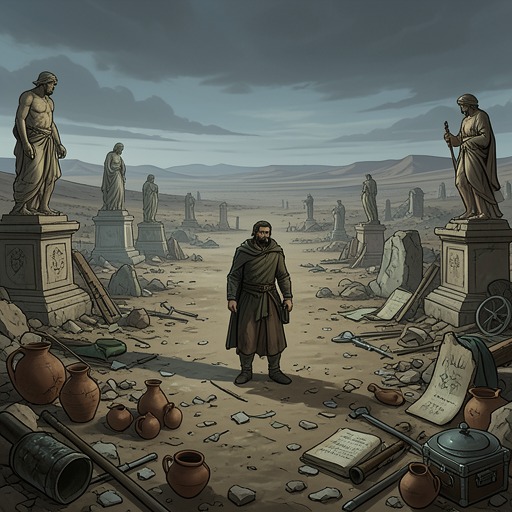
The planet’s transformation is violent and immediate. Mountains crumble or vanish, lakes become muddy plains, and storms appear and disappear without warning. Grasslands shift toward native life while alien forests wither, and transplanted organisms sometimes simply die rather than returning to a prior ecological state. Cato, Raine, and Leese observe the changes from orbit and from the surface, confronting the difficulty of understanding planetary-scale alteration even while witnessing it directly. Cato acknowledges that undoing the damage will take years, but insists that Sydea will belong to its inhabitants again.
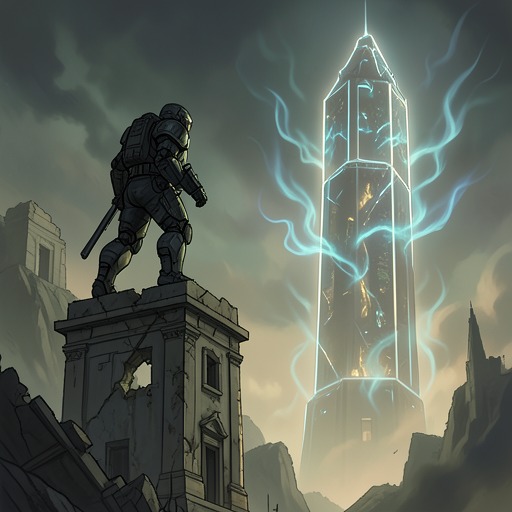
The final dungeon is Platinum-ranked and contains enormous burrowing metal wyrms. Cato’s four warframes reach its core despite the resistance, and he crushes it before transmitting himself away to watch the result from orbit. The dungeon site wavers and disappears; the transparent portals in the two major cities shrink, flicker, and vanish in unison. For the first time, people can walk beyond their walls without being attacked by monsters, and they can look into the sky without fearing winged predators. Children born under the System are no longer confined to combat or to the whims of godlings.
Reconstruction and Division of Labor
Liberation immediately exposes the material cost of removing a world-supporting infrastructure. Cato has to assume total ecosystem collapse as a possibility, including the loss of the single-celled life responsible for producing oxygen. The System had regulated conditions such as atmosphere without accounting for the ordinary biological processes that make a real environment viable; after its removal, survival depends on the unglamorous details of air, food, decomposition, and nutrient cycles. Sydea’s reconstruction is consequently an exercise in replacing invisible support systems as much as rebuilding visible cities.
Cato gives the Sydeans orbital infrastructure and does not attempt to govern the planet personally. The former Platinums inherit the responsibility. Onswa retains planetary surveillance and the force needed to stabilize the towns. Arene controls the railguns remaining in orbit and supervises industrial fires as factories are established outside the cities and towns, while Sydeans learn to operate the unfamiliar machinery. Hirau leads repairs to the land, and Marek directs work on the seas. Their separate responsibilities turn the former System hierarchy into a distributed reconstruction effort, though the damage remains immense even with Cato contributing heavily.
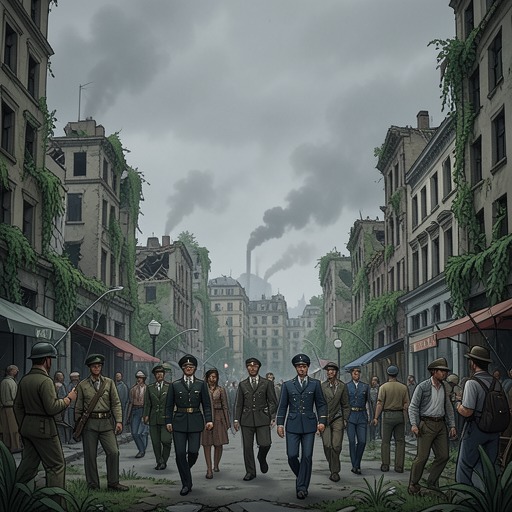
Karsa takes charge of rebuilding cities and establishing education. Her work is deliberately practical rather than centered on the advanced knowledge Cato possesses: she teaches proper cleaning, writing, and cooking, among other ordinary skills. The contrast is important. The future cannot be secured by orbital weapons and automated factories alone; it also requires habits, literacy, food preparation, and a population able to manage daily life without System mediation. Karsa personally helps set a building’s metal spine into place, lending her labor to a new city because public participation makes the change visible and helps people trust the unfamiliar order taking shape around them.
Ecological and Social Aftermath
The reconstruction remains precarious because System collapse produces cascading ecological failures rather than a single, completed disaster. On Heyk, a later world undergoing the same broader process, massive plant die-offs reduce oxygen levels, while the absence of native bacteria capable of decomposing alien biomatter leaves weathered husks that cannot decay or be recycled. Sydea’s scars are similarly expected to last for years or decades despite the biological factories Cato prepares. These consequences clarify what Sydea demonstrates first: removing an artificial planetary order does not restore a pristine past, because the System has altered geology, species distributions, infrastructure, and social expectations too deeply.
The event also changes how power is understood across the wider System. Later, the ruling powers discover that Cato’s forces have spread throughout both the frontier and the Inner Worlds, turning what had seemed like a local disturbance into a systemic threat. The revelation forces consideration of world-purging as a possible response, but the scale makes that solution politically and materially untenable: destroying one compromised world might be concealed, whereas purging every affected Inner World would expose the failure of the campaign against Cato. Sydea thus becomes both a liberated society and a strategic precedent, proving that System dependence can be broken and that the consequences cannot be contained to one planet.
Narrative Significance
Sydea’s Liberation and Reconstruction rejects the fantasy that liberation ends when the oppressor disappears. The System’s collapse creates a second apocalypse: supported mountains fail, alien forests die, portals close, towns go dark, and ecological processes that had been hidden behind System regulation become urgent political problems. Cato’s intervention is therefore judged not only by whether he can destroy an anchor or a dungeon core, but by whether he can make the aftermath survivable.
The event’s central contrast is between imposed choice and difficult freedom. Under the System, Sydeans have food, infrastructure, and recognizable institutions, but their lives are narrowed to combat, dungeon survival, and obedience to godlings. After the collapse, those supports vanish, yet people can leave their walls, look at an unthreatening sky, learn to build, write, cook, and govern, and imagine lives not defined by violence. Reconstruction preserves the people while dismantling the system that made their old world possible. That tension becomes the enduring significance of Sydea’s liberation: the destruction of domination is only the opening act of building a reality in which freedom can endure.